
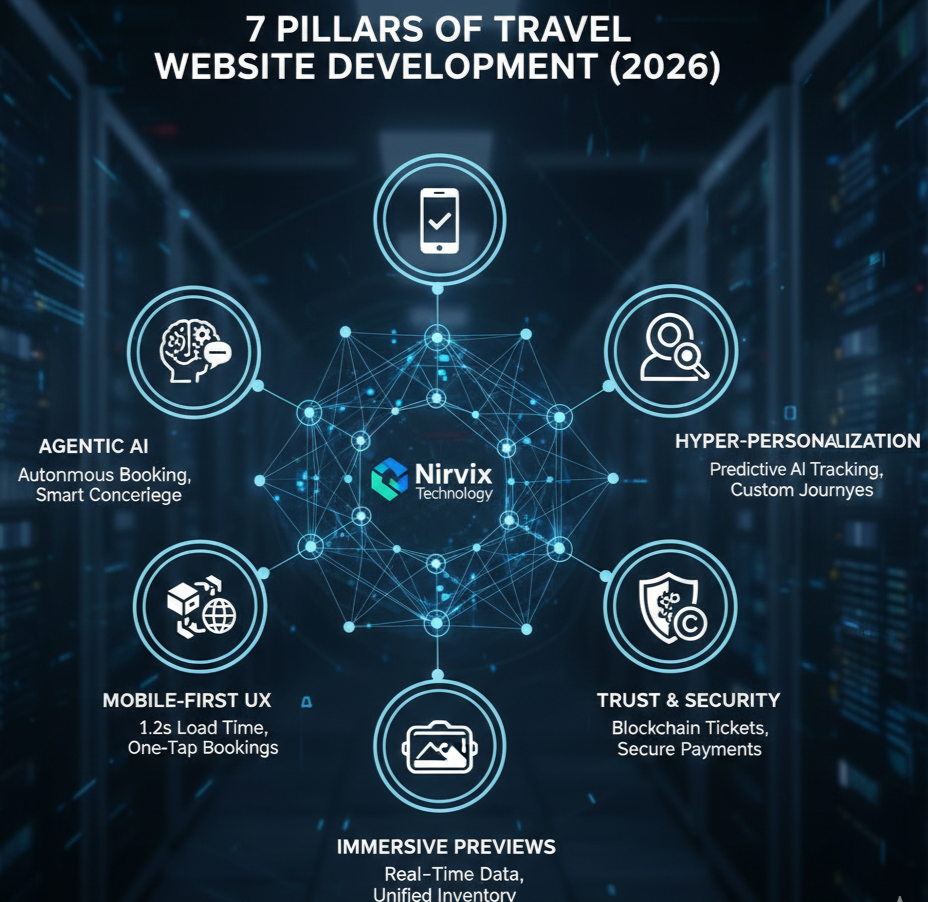
As a software development leader, Nirvix Technology approaches travel website creation not just as a design task, but as a high-stakes engineering project. In 2026, a travel site must be a high-performance ecosystem that converts “window shoppers” into confirmed adventurers.
Here is our professional, step-by-step roadmap to engineering a world-class travel platform.
1. The Digital Foundation: Domain & High-Velocity Hosting
Your domain is your brand’s digital identity. At Nirvix, we recommend choosing a name that is concise, keyword-relevant, and uses the .com TLD for global commercial trust.
However, the real engine is your Hosting. For a travel site, standard shared hosting is often insufficient.
- Architecture: We advocate for cloud-based hosting (like AWS or Google Cloud) paired with a Content Delivery Network (CDN).
- Why it matters: Travel sites are image-heavy. A CDN ensures that a user in London and a user in Kathmandu both see your high-res gallery in under 1.2 seconds by serving data from the nearest edge server.
2. Content Management: Why We Power Travel via WordPress
While there are many platforms, WordPress remains the gold standard for travel agencies because of its unparalleled flexibility and massive ecosystem of travel-specific APIs.
- Customization: It allows us to build “Headless” architectures where the backend is WordPress (for easy staff updates) but the frontend is built with high-speed frameworks like Next.js.
- Scalability: It easily handles the “Topic Cluster” SEO model required to rank for thousands of different destination keywords.
3. Cognitive Design: Merging UI Brilliance with UX Logic
A travel site should be an emotional experience. We divide our design process into two distinct phases:
- User Interface (UI): Focuses on “The Vibe.” We use high-fidelity, optimized imagery and a consistent color palette that evokes a sense of adventure or luxury.
- User Experience (UX): Focuses on “The Flow.”
- Frictionless Navigation: A user should be able to find a specific tour package in no more than three clicks.
- Mobile-First Indexing: Since over 70% of travel searches happen on phones, our designs start on mobile and scale up to desktop, not the other way around.
4. Structural Integrity: Site Hierarchy & Strategic Pages
Google’s crawlers need a map, and so do your users. We organize travel sites into a logical pyramid:
- The Pillar Pages: High-level categories like “International Tours” or “Trekking in Nepal.”
- The Spoke Pages: Specific itineraries (e.g., “14-Day Everest Base Camp Trek”).
- Trust Pages: “About Us” and “Contact” pages are not just fillers; they are critical E-E-A-T (Experience, Expertise, Authoritativeness, Trustworthiness) signals for Google’s 2026 ranking algorithm.
5. The Conversion Engine: Booking & Secure Payments
The heartbeat of your site is the booking engine. At Nirvix, we provide two paths:
- API Integration: We connect your site to global booking platforms (GDS) so you can offer real-time flight and hotel availability.
- Custom Booking Logic: For niche agencies, we build proprietary systems that manage custom group sizes, seasonal pricing, and “Early Bird” discounts.
- Security: Every transaction is protected via SSL Encryption and complies with PCI-DSS standards, supporting everything from Stripe and PayPal to local digital wallets.
6. Digital Amplification: SEO & Social Ecosystems
A beautiful site is useless if it’s invisible. We implement a multi-layered SEO strategy:
- Keyword Intelligence: We target “Long-Tail” intents (e.g., “Best luxury honeymoon packages in Pokhara”) rather than just broad terms.
- Social Proof: We don’t just add social icons; we integrate live social feeds. Seeing real-time photos from your current travelers on Instagram builds more trust than any marketing copy ever could.
7. Pre-Flight Check: Testing & Continuous Evolution
Before Nirvix takes a site live, it undergoes a rigorous “Stress Test”:
- Cross-Browser Audits: Ensuring the site looks perfect on Safari, Chrome, and Firefox.
- Vulnerability Scanning: Checking for any security loopholes in the code.
- Performance Monitoring: Using Google Search Console and Analytics to track how users interact with your “Call to Action” (CTA) buttons.
Is your current website losing you bookings? At Nirvix Technology, we specialize in transforming outdated travel portals into high-converting booking machines. Let’s build your digital frontier together.
Contact our Development Team | Explore our Travel Tech Portfolio